Ingredients
Metric weights use grams. US weights use ounces; liquids use fluid ounces. Conversions are rounded. Spoon measures use 5 ml teaspoons and 15 ml tablespoons; cups use 240 ml.
Serves 4
Choose any positive whole number of servings. Ingredients and measured amounts in steps scale together. Times, temperatures and equipment stay unchanged. For larger yields, cook separate original-size batches. Counted ingredients can become fractions; beat eggs before dividing them. Fixed correction-water checks remain fixed.
Main ingredients
Seasoning and finishing
Liquids
Equipment
Blender; large heavy saucepan with lid; measuring jug; spoon; fork.
Check all product labels and cross-contact. Diet groups describe this listed draft, not every substitution.
Steps
Prepare the paste · About 1 min
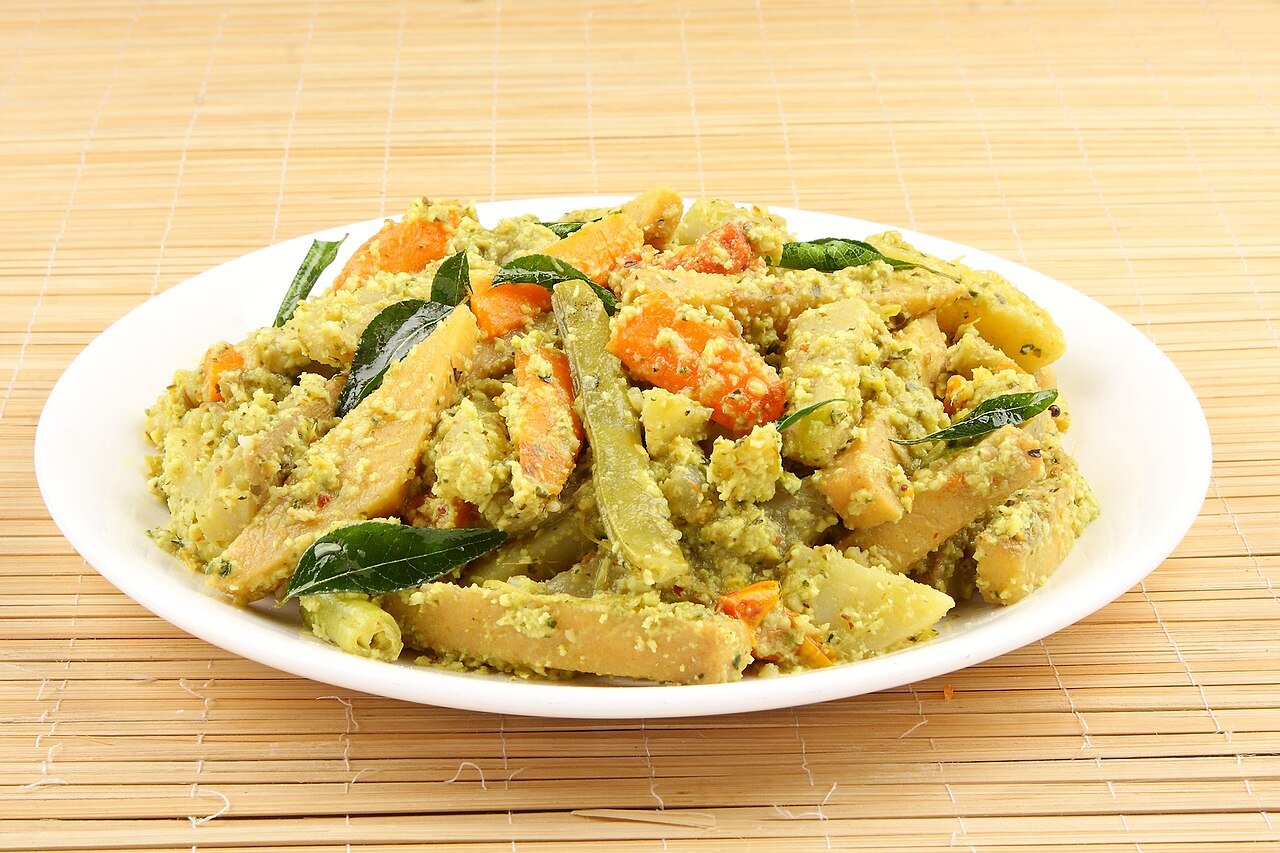
- Cut the prepared vegetables into similar batons about 5 cm long and 1 cm thick.
- Put 240 ml grated fresh coconut, 2 green chilies, 1 tsp cumin seeds and 120 ml water, divided; more if needed in the blender.
- Blend briefly.
Check: The coconut should remain coarse rather than become a smooth cream.
Cook the firmer vegetables · About 15 min
- Put 240 ml elephant-foot yam, peeled and cut, 240 ml moringa pods, cut into lengths and 120 ml green beans, cut in the saucepan.
- Add the remaining 240 ml water, divided; more if needed, ½ tsp turmeric and ½ tsp salt, adjust to taste.
- Bring the water to a gentle boil over medium heat.
- Cover the saucepan.
- Simmer over medium-low heat for 12–15 minutes.
Check: The yam should begin to soften; it must cook fully before serving.
Add the remaining vegetables · About 12 min
- Add 240 ml ash gourd, cut into batons, 240 ml pumpkin, cut into batons, 240 ml Mangalore cucumber, cut and 240 ml raw plantain, peeled and cut.
- Cover the saucepan.
- Cook over medium-low heat for 10–12 minutes.
Check: A fork should enter most pieces, with slight resistance remaining.
- If the pan starts drying, add hot water 2 tablespoons at a time.
- Fold in the coconut paste.
- Simmer for 5–7 minutes.
Check: The vegetables should be fully tender and retain their shapes.
Finish without boiling · About 5 min
- Reduce the heat to its lowest setting.
- Fold in 240 ml plain yogurt, whisked.
- Warm for 1 minute without boiling.
- Turn off the heat.
- Add 1 ½ tbsp coconut oil and 12 curry leaves.
- Cover the saucepan for 5 minutes.
- Serve warm.
Check: Moringa pods have fibrous outer shells; eat the soft inside and discard the shell.
Tips
- Use the specified vegetables for fridge matching; seasonal substitutions are not assumed.
Substitutions
- Use carrots and beans instead of some pumpkin.
Storage
- Refrigerate perishable food within two hours, or within one hour in heat above 32°C / 90°F. Store covered at 4°C / 40°F or below. Use within two days for this draft.
- Reheat cooked dishes to 74°C / 165°F, stirring or turning for even heating. Serve cold salads, dips and chilled desserts directly from safe refrigeration.
- For sauces and soups, add a little water if thick and reheat gently. Crisp coatings soften after storage.
Make ahead
- Chop vegetables and refrigerate one day ahead; grind coconut paste shortly before cooking.
FAQ
Why add yogurt off heat?
It reduces splitting and keeps the sour flavour fresh.
Can I make it vegan?
Use plain coconut yogurt; the flavour changes.
How should I store kerala avial?
Refrigerate perishable food within two hours, or within one hour in heat above 32°C / 90°F. Store covered at 4°C / 40°F or below. Use within two days for this draft.
Recipe source and adaptation
Measured home adaptation: Dassana's Veg Recipes: Kerala aviyal.
Yogurt-based version; vegetables vary seasonally.
Food safety references
FoodSafety.gov: cooking temperatures · Food Standards Agency: rice storage and reheating